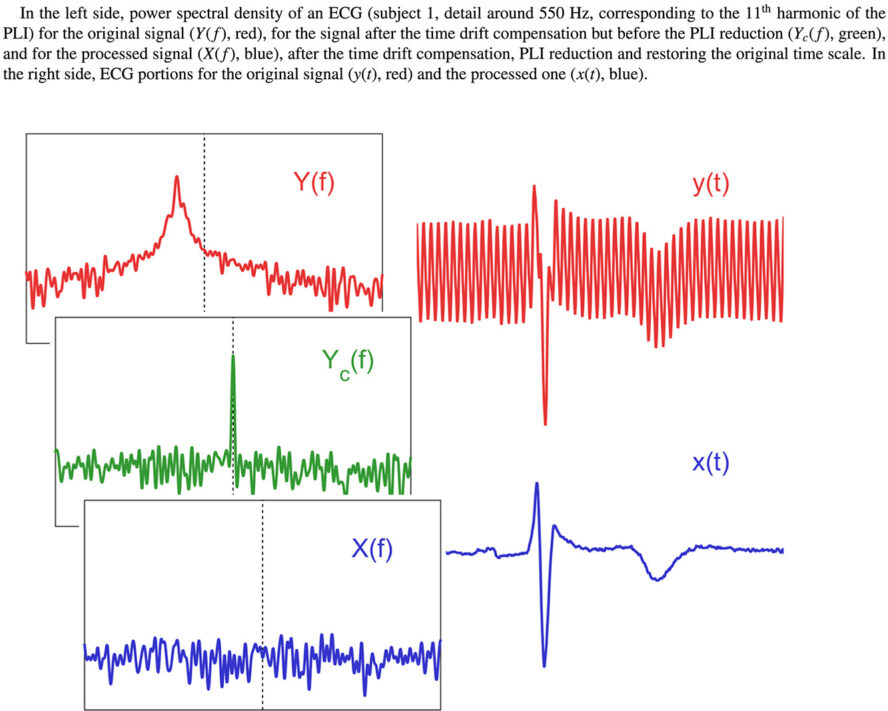
(Abstract) The 50/60 Hz power line interference (PLI) usually causes significant degradation to biopotentials and other low amplitude electrical signals. In this manuscript a numerical procedure for the reduction of the PLI interference, based on time drift compensation, is presented. The time drift compensation provides the cancellation of the PLI frequency drift and the minimization of the spectral width of the PLI harmonics, which allows an efficient reduction of this interference with minimum distortion of the signal of interest. The procedure (A) selects one PLI harmonic appropriate for the estimation of the time drift associated to the frequency drift and estimates the time drift by phase demodulation of the selected harmonic; (B) transforms the signal to a time scale where the time drift (and therefore also the frequency drift) is canceled; (C) efficiently reduces the PLI components with minimal distortion of the signal; and finally (D) transforms the signal back to the original time scale. The procedure provides biopotentials substantially free of PLI. Examples of MatLab/Octave implementations of the procedure are provided, as well as examples of applications in the context of electrocardiography and auditory evoked potentials. The proposed method, applied to signals acquired in real scenarios, provides a substantial improvement with respect to conventional notch comb filtering without time drift compensation.
The open-access article describing the algorithm for the reduction of the power line interference (PLI) can be downloaded in:
- de la Torre A, Alvarez IM, Muñoz-Orellana, JA. A phase-demodulation based time drift compensation for the reduction of the 50/60 Hz power line interference in biopotentials. Biomedical Signal Processing & Control (2026) 115. 109423. doi: 10.1016/j.bspc.2025.109423
Open access
Click on the “View PDF” to download the manuscript.
Click on “Supplementary Data” to download the Supplementary Material in a zip file. This material includes a detailed pdf document as well as Matlab/Octave code implementing the proposed procedure.