


| GRANT ID | BUDGET |
| PID2024-161211OA-I00 | €152.5k |
INTEL-MAR (2025–2028) is a research project funded by the Spanish Ministry of Science and coordinated by the University of Granada. The project develops advanced Structural Health Monitoring and Digital Twin technologies for coastal and maritime infrastructures exposed to climate change. By combining laboratory experiments, artificial intelligence, numerical modelling, and transfer learning, INTEL-MAR aims to enable early damage detection and support resilient, data-driven maintenance strategies for structures such as breakwaters and bridge piers in coastal environments.
Project website
| GRANT ID | BUDGET |
| 101209678 | €209,914.56 |
Path-B SHM (2026–2028) is a Marie Skłodowska-Curie Postdoctoral Fellowship project coordinated by the University of Granada. The project introduces a novel paradigm for the monitoring of cultural heritage structures based on pathology-driven Structural Health Monitoring. By combining systematic structural diagnosis, multi-class Digital Twins, artificial intelligence, and Bayesian inference, Path-B SHM aims to identify and quantify structural damage in near real time, supporting more reliable and data-informed preservation strategies for historic constructions.
Project website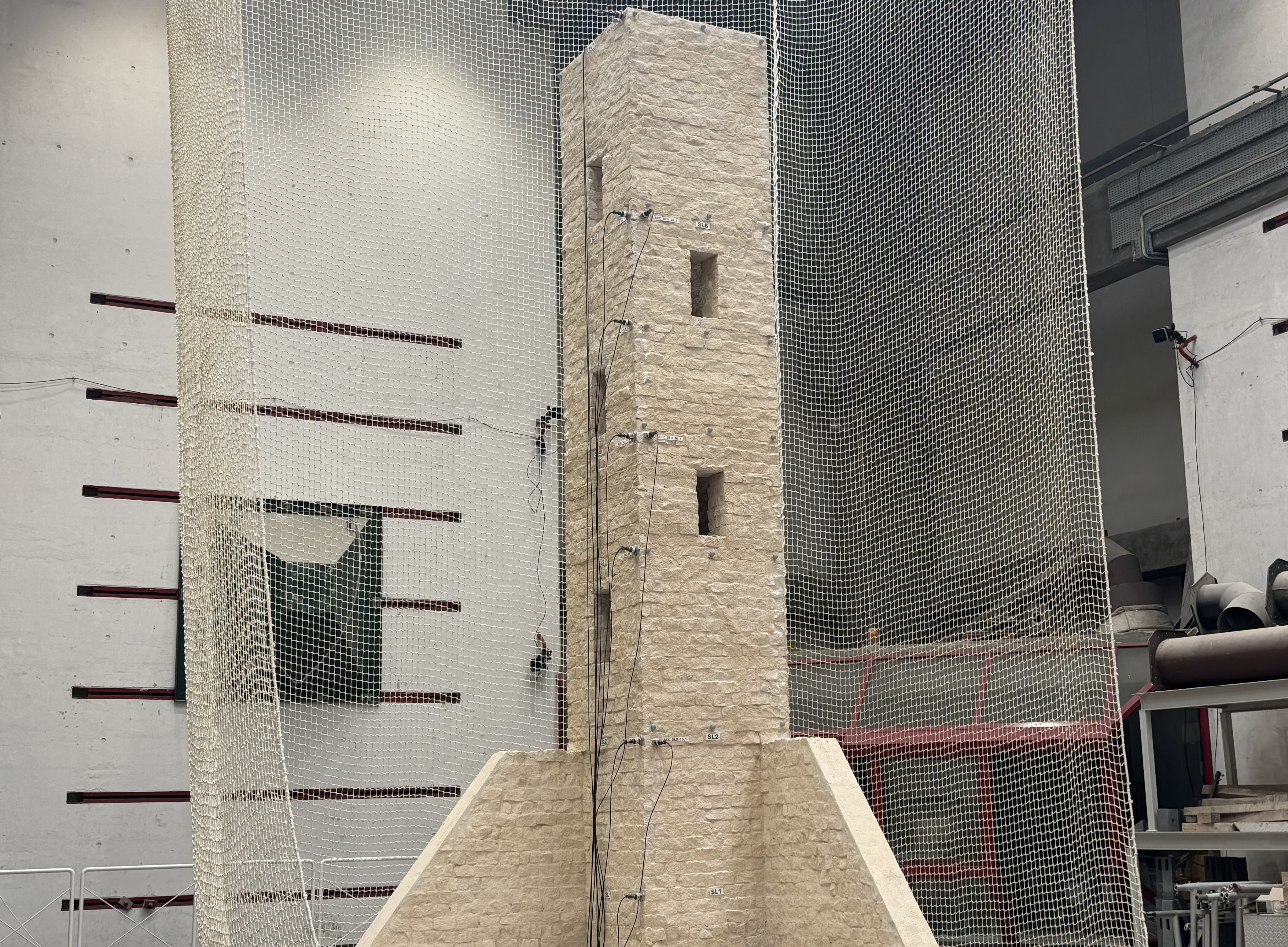
| GRANT ID | BUDGET |
| 101058684 | Access to LNEC facilities |
ERIES-VERDI (2022–2026) is a Horizon Europe project focused on the development and validation of vibration-based methodologies for rapid post-earthquake damage identification in historic masonry towers. The project combines large-scale shaking table experiments, structural health monitoring, and advanced dynamic identification techniques to assess the capability of vibration data to detect, localize, and quantify earthquake-induced damage in heritage structures. Experimental activities were conducted at the National Laboratory for Civil Engineering (LNEC) in Lisbon using a scaled masonry tower subjected to a series of seismic excitations.
Project website imis.laboratory@gmail.com

